

Key Takeaways
- Talent Acquisition Strategy: Anduril’s "AI Grand Prix" is a strategic move to identify and recruit top-tier engineers for autonomous flight systems amidst a global talent shortage.
- Shift to Software: The competition highlights the industry's pivot from hardware-centric design to software-defined warfare, prioritizing AI drone software over airframe kinematics.
- Swarm Capability: The event aims to accelerate the development of "Lattice," Anduril's operating system, enabling single-operator control of large-scale autonomous drone swarms.
- Market Divergence: While consumer drone prices drop due to hardware commoditization, defense tech valuation is increasingly tied to proprietary AI and edge computing capabilities.
The Race for the Ultimate Pilot: Code, Not Cockpits
In the rapidly evolving landscape of US defense tech, the era of the "joystick pilot" is drawing to a close. Anduril Industries, the defense technology unicorn founded by Palmer Luckey, has officially announced the "AI Grand Prix," a high-stakes engineering competition scheduled for 2026. While on the surface this appears to be a standard robotics challenge, industry analysts recognize it as a pivotal moment in the development of autonomous drone swarms.
The Grand Prix is not merely a race; it is a stress test for the future of aerial combat and surveillance. As modern warfare shifts toward asymmetric threats and mass-deployment strategies—echoed by the Pentagon's "Replicator" initiative—the bottleneck is no longer the hardware. It is the cognitive load on the operator. Anduril’s initiative seeks to solve this by crowdsourcing the best minds in AI drone software to perfect systems that can fly, fight, and survive without direct human intervention.
For enterprise observers and military procurement officers, this signals a massive shift in value proposition: the airframe is the commodity; the autonomy is the asset. For a deeper dive into how the military is currently procuring these assets, refer to our 2026 Buying Guide on US Military Drones.
Recruiting Through Combat (Simulation)
The shortage of specialized engineers in the aerospace and defense sectors has reached critical levels in the United States. Traditional recruitment methods are failing to keep pace with the demand for expertise in computer vision, sensor fusion, and edge computing. The Anduril AI Grand Prix serves a dual purpose: accelerating R&D and serving as the ultimate job interview.
According to recent reports, Anduril is utilizing this competition specifically to recruit top engineers who can navigate the complexities of kinetic environments. Observer reports that the initiative is designed to pull talent directly from the most competitive university programs and private sector labs, pitting them against real-world scenarios that Anduril’s Lattice OS faces daily.
"We are moving past the age where a pilot ratio of 1:1 is acceptable. The future is 1:100. To achieve that, we don't need better sticks; we need better code. The AI Grand Prix is about finding the architects of that future." — Industry Analyst Note
This gamification of recruitment allows Anduril Industries to assess candidates not on their resumes, but on the efficiency, resilience, and creativity of their algorithms. In a field where a millisecond of latency or a false positive in object detection can mean mission failure, seeing code perform in a high-pressure, adversarial simulation is invaluable.
The Great Divergence: Consumer Hardware vs. Defense Software
To understand the significance of Anduril's focus on software, one must look at the contrasting state of the consumer market. In the consumer sector, hardware has become incredibly capable yet increasingly commoditized, driving prices down.
A prime example of this trend is the recent pricing behavior of DJI. As reported by Mashable, the DJI Mini 5 Pro has seen significant price reductions, signaling that even cutting-edge consumer hardware is subject to intense market saturation and price wars. While consumers benefit from cheaper 4K cameras and obstacle avoidance, the defense sector cannot rely on commercial off-the-shelf (COTS) software stacks that require constant connection to the cloud or a human pilot.
This divergence is creating two distinct tiers of drone technology:
- Tier A (Consumer/Prosumer): High-quality hardware, reliant on GPS, vulnerable to jamming, 1:1 pilot ratio.
- Tier B (Defense/Enterprise): Agnostic hardware, reliant on visual navigation (VIO), jam-resistant, N:1 pilot ratio (swarms).
The Anduril AI Grand Prix is squarely focused on Tier B. The goal is to create systems that can operate in "denied environments"—areas where GPS is jammed and radio communications are severed. This requires autonomous flight systems that can make tactical decisions locally on the drone's onboard chipset.
The Rise of Autonomous Swarms
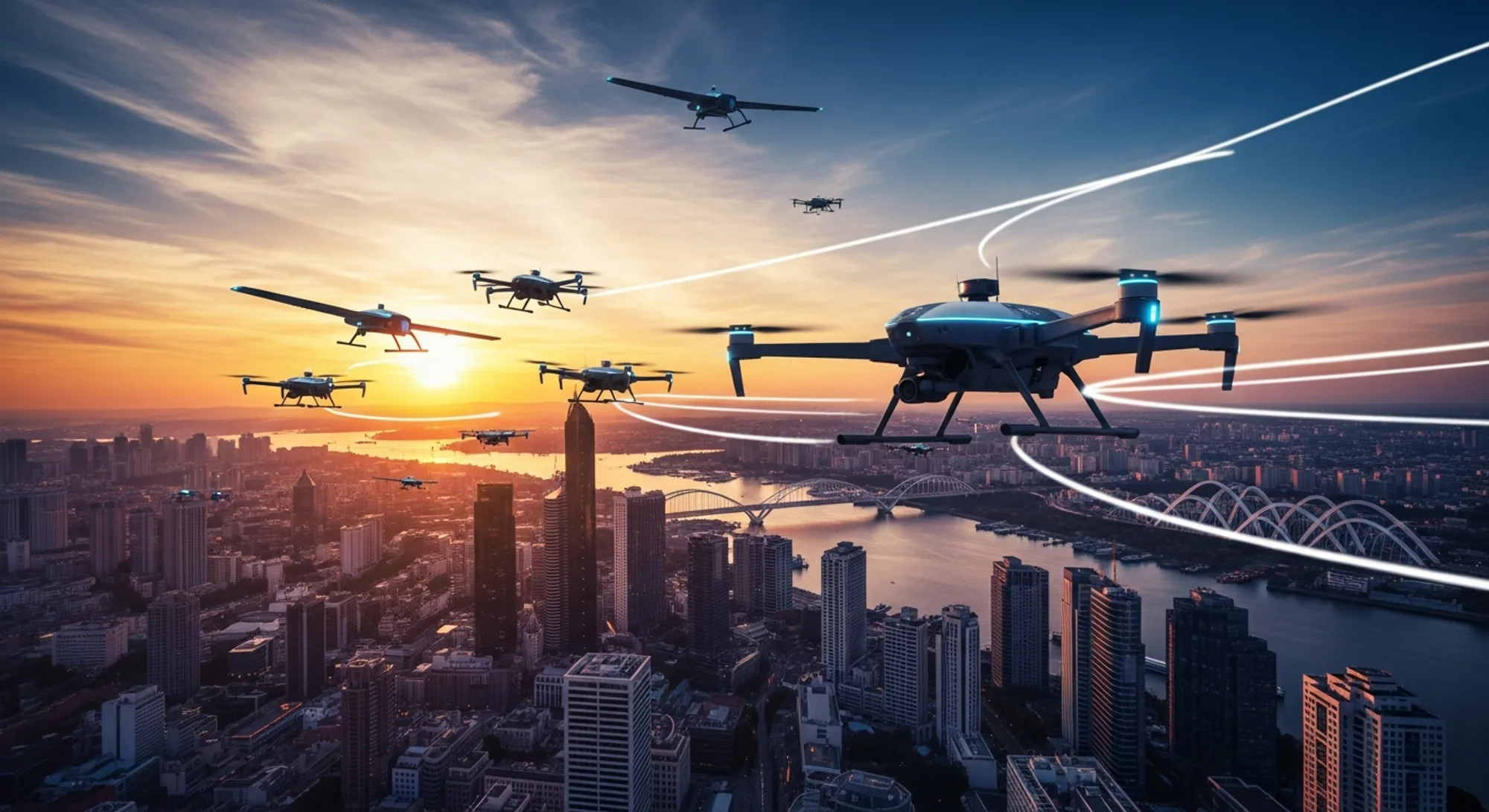
The ultimate objective of the AI Grand Prix is to refine the logic required for swarming. Swarm technology mimics biological systems (like bees or starlings) where individual units communicate to achieve a collective goal. In a defense context, this means a single operator can deploy dozens of drones to suppress enemy air defenses or conduct wide-area reconnaissance.
However, the data processing requirements for swarms are astronomical. Recent incidents highlight the sheer volume of data modern drones collect. For instance, Yahoo News reported on researchers using drones to spot dozens of sharks in mere minutes of flight time. In a military context, replacing sharks with hostile combatants creates a data stream that no human analyst can process in real-time.
This is where AI drone software becomes the kill chain. The software must identify, classify, and prioritize targets instantly, sharing that data across the swarm without sending heavy video files back to a base station. The engineers competing in the Grand Prix will be tasked with solving these specific bandwidth and processing bottlenecks.
For those interested in how these autonomous systems are applied in the commercial sector, see our report on 2026 Autonomous Inspection Trends.
Navigation in Denied Environments
One of the critical components of the competition will likely involve navigation without Global Positioning Systems (GPS). Electronic warfare has made GPS unreliable in conflict zones like Ukraine and the Middle East. Anduril’s competitors will need to demonstrate "visual odometry" and map-matching capabilities.
This technology is not exclusive to the military; it is also vital for urban operations where skyscrapers block satellite signals. We discuss the civilian application of these technologies in our guide on Drone Navigation Systems and Precision Guides.
The Future of Drone Engineering Jobs
The launch of the AI Grand Prix underscores a booming job market for a specific breed of engineer. The skillset required is a hybrid of robotics, aerospace engineering, and deep learning. Drone engineering jobs are shifting away from aerodynamics—which is largely a solved problem—toward the "brain" of the machine.
We are seeing a trend where major defense contractors are competing with Big Tech (Google, Meta) for the same talent pool. By creating a high-visibility event like the Grand Prix, Anduril is positioning itself as the premier destination for engineers who want their code to have a tangible, kinetic impact on national security.
For readers looking to enter this space, understanding the regulatory environment is just as critical as understanding the code. The integration of these swarms into the National Airspace System (NAS) remains a hurdle. Learn more about how authorities are managing this influx in our analysis of Remote ID Compliance and 2026 FAA Guidelines.
Conclusion
Anduril’s AI Grand Prix is more than a PR stunt; it is a microcosm of the future of warfare. As the US accelerates its shift toward autonomous systems to counter near-peer adversaries, the intellectual property generated in these competitions will likely form the backbone of the next generation of air superiority. For the engineers involved, it is the opportunity of a lifetime. For the drone industry, it is confirmation that the future is autonomous, collaborative, and software-defined.
Sources & Further Reading
- Observer - Defense Tech Startup Anduril Launches ‘AI Grand Prix’ to Recruit Top Engineers
- Mashable - DJI Mini 5 Pro Price Analysis and Market Trends
- Yahoo News - Drone Footage Capabilities and Data Volume Analysis
- Reuters Technology - Global Trends in Autonomous Systems
- MIT Technology Review - Developments in AI and Edge Computing
