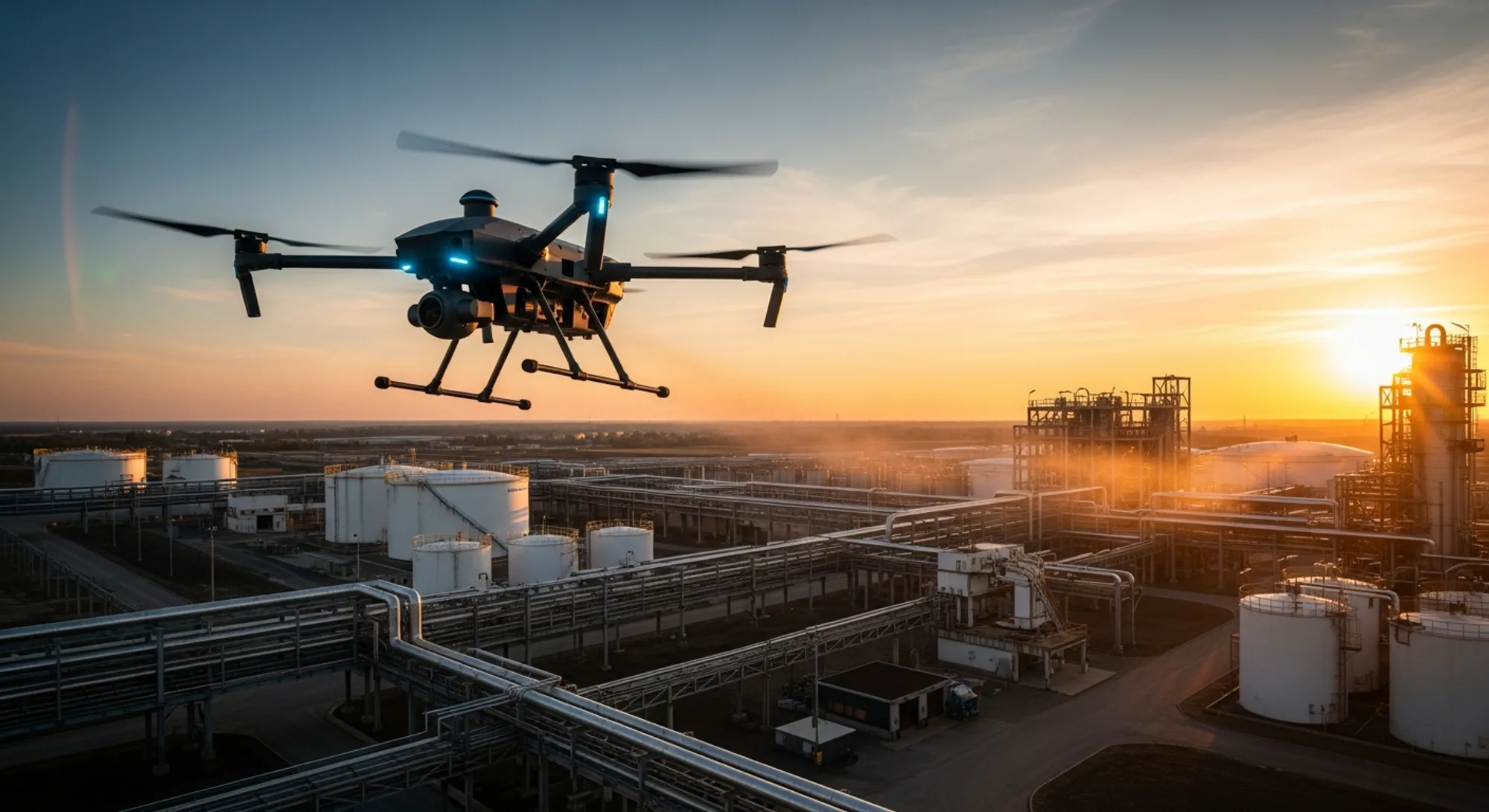

Key Takeaways
- BVLOS is the New Standard: By 2026, Beyond Visual Line of Sight operations have transitioned from experimental waivers to standardized commercial drone operations, driven by robust regulatory frameworks.
- AI-Driven Autonomy: Enterprise inspection has shifted from "pilot-in-the-loop" to "pilot-on-the-loop," where AI handles data capture and obstacle avoidance while humans manage mission parameters.
- Security Concerns Rise: Recent international incidents involving civilian drones being engaged by security forces highlight the urgent need for integrated Remote ID and de-confliction protocols.
- Component Precision: The focus for 2026 hardware has moved to high-reliability motion control and navigation systems to ensure 99.9% uptime for critical infrastructure monitoring.
As we settle into 2026, the narrative surrounding enterprise drone usage has fundamentally shifted. We are no longer discussing the potential of unmanned systems; we are analyzing the reliability of fully autonomous workflows. For years, the "holy grail" of the industry was the ability to deploy a drone from a box, have it inspect a cell tower or a mile of pipeline, and return to charge—all without a human standing in a field holding a controller. That reality is now here, but it brings with it a complex web of regulatory nuances and technological requirements.
I have spent the last decade covering the slow march toward automation, but 2026 marks the year where autonomous drone inspection creates a definitive split in the market. There are toys, and then there are tools. For US enterprise sectors, the adoption of automated flight systems is no longer just about saving money; it is about data consistency and safety in an increasingly crowded airspace.
The Regulatory Thaw: BVLOS Regulations 2026
The biggest hurdle for US infrastructure monitoring has never been the technology; it has been the law. However, the regulatory landscape has matured significantly. The Federal Aviation Administration (FAA) has moved past the era of restrictive, case-by-case exemptions into a more streamlined performance-based rule set for Beyond Visual Line of Sight (BVLOS) operations.
While obtaining permission still requires diligence, the pathway is clearer. We are seeing a shift where BVLOS regulations 2026 focus heavily on the reliability of the C2 (Command and Control) link and the Detect and Avoid (DAA) capabilities of the aircraft. If you are navigating the complex paperwork of modern operations, I highly recommend reviewing our guide on Part 107 Waivers (2026): US Drone Pilot Guide to understand how the waiver process has evolved into a stepping stone for standard certifications.
The Global Warning Sign
However, regulation is not just about permission; it is about protection. The integration of commercial drones into civil airspace is not without friction. A recent incident reported by sUAS News concerning Europe's first drone being shot down in civil airspace serves as a stark warning for US operators. This event underscores the tension between autonomous security drones and civil liberties, as well as the potential for misidentification in sensitive airspace.
For US enterprise operators, the lesson is clear: compliance with Remote ID and ADS-B Out is not optional—it is a survival mechanism for your hardware. Without proper identification, an expensive enterprise asset looks identical to a security threat.
Simon’s Pro Tip: Never skimp on transponders. In 2026, if your drone cannot electronically "shout" its identity to local authorities and other aircraft, you are risking a total loss of the airframe. Check our ADS-B Transponders (2026): US Drone Pilot Buying Guide for compliant options.
Hardware Evolution: Precision Components
The shift toward full autonomy places immense stress on the internal components of the aircraft. When a human pilot flies, they can compensate for a slight motor vibration or a GPS drift. An autonomous system, however, relies on absolute precision data. If the data is bad, the drone crashes.
This demand for reliability is driving the component market. For example, sUAS News reports that Allient Inc. is showcasing advanced motion control technologies at UAV Technology USA 2026. This indicates a trend where the focus is moving away from just "longer battery life" to "motion precision." Enterprise buyers are now looking at the Mean Time Between Failures (MTBF) of servos and actuators just as closely as they look at camera resolution.
To achieve the centimeter-level accuracy required for automated structural inspections (such as examining bolt corrosion on a bridge), the navigation stack must be flawless. We are seeing a move away from relying solely on GPS. Visual inertial odometry and LiDAR-based SLAM (Simultaneous Localization and Mapping) are now standard on enterprise rigs. For a deeper dive into how these systems keep drones stable without human input, read our analysis on Drone Navigation Systems (2026): US Pilot's Precision Guide.
The Human Element in an Automated World
One of the most persistent myths about enterprise drone technology is that it eliminates the pilot. In 2026, we are finding that it actually elevates the pilot's role. The industry is transitioning from "stick-and-rudder" skills to systems management. The pilot is no longer flying the drone; they are managing the mission.
This shift is global. As highlighted by sUAS News coverage of Drone Pilots Portugal, training organizations worldwide are restructuring their curriculum to focus on complex mission planning, regulatory compliance, and fleet management rather than just manual flight maneuvers. US operators must take note: the value you bring to a client is no longer your thumbs; it is your ability to interpret data and manage autonomous workflows.
Commercial Drone Operations: The "Drone-in-a-Box" Reality
The most visible manifestation of this trend is the proliferation of docking stations, or "Drone-in-a-Box" (DiaB) solutions. These systems allow for:
- Scheduled Patrols: Drones launch automatically at set intervals to patrol perimeters.
- Triggered Response: Alarm sensors on a fence line trigger the drone to launch and investigate a specific sector.
- Remote Offloading: Data is uploaded to the cloud immediately upon landing/charging.
This level of commercial drone operations requires a robust C2 link. The integration of 5G and satellite communications has largely solved the range anxiety of previous years, allowing a pilot in Houston to oversee an inspection in West Texas. However, this connectivity introduces new vulnerabilities.
Security and Counter-UAS Integration
As we rely more on autonomous agents for US infrastructure monitoring, the security of the drones themselves becomes paramount. We are seeing a convergence of drone operations and Counter-UAS (C-UAS) technology. Enterprise sites need to distinguish between "friendly" autonomous drones and unauthorized intruders.
This is leading to integrated dashboards where the facility manager sees their own inspection drones alongside tracked unauthorized targets. If you are managing a sensitive site, you cannot ignore the defensive side of the equation. We discuss this emerging market duality in our report on Counter-UAS Market Heats Up: Nexus C2 Integration 2026.
The Road Ahead
The trends for 2026 are clear. The hardware is becoming more rugged and precise, driven by companies like Allient Inc. The regulations are opening up the skies for BVLOS, provided operators can prove safety and identification. And the pilot's role is evolving into a high-level systems administrator.
For US enterprise companies, the time for "testing" is over. The technology is mature enough for full-scale deployment. The competitive advantage will go to those who can integrate these automated flight systems into their existing data workflows seamlessly, ensuring that the drone is not just a flying camera, but an intelligent node in the corporate network.
Sources & Further Reading
- sUAS News - Europe’s First Drone Shot Down: A Line Crossed in Civil Airspace
- sUAS News - Allient Inc. to Attend UAV Technology USA 2026
- sUAS News - Drone Pilots Portugal and Training Standards
- DroneLife - Breaking News in the Drone Industry
- IEEE Spectrum - Aerospace & Engineering News