

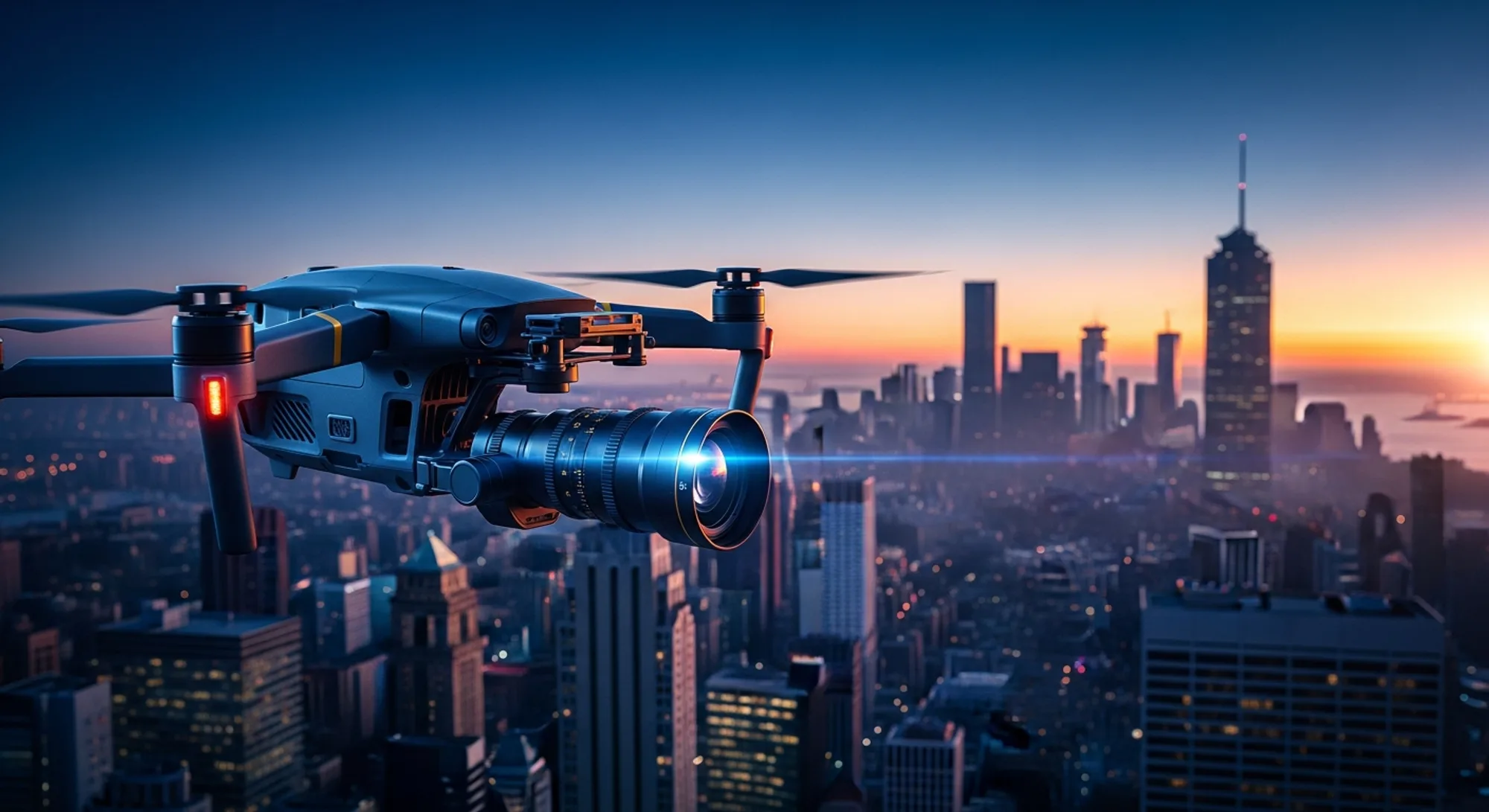
Key Takeaways
- Sharpness penalty is inevitable: Even premium anamorphic filters reduce center sharpness by approximately 10-15% compared to stock glass.
- Desqueeze workflow matters: Most consumer drones do not support in-camera desqueezing, requiring external monitors or disciplined framing imagination.
- Flare quality varies wildly: Freewell lenses tend to offer punchier, saturated streaks, while Moment optics provide subtler, more organic roll-off.
- Sensor compatibility: Anamorphic adapters work best on 4/3 sensors (Mavic 3 series) where the resolution overhead can hide optical imperfections.
There is a specific obsession in the drone community with the "Hollywood look." We buy ND filters to force motion blur, we shoot in Log profiles to maximize dynamic range, and recently, we have started clipping heavy glass onto our gimbal cameras in pursuit of the holy grail of cinema: the anamorphic streak.
As a camera systems specialist, I view these accessories with deep skepticism. Placing additional glass in front of a precisely calibrated lens element usually results in optical degradation. However, the promise of a wider field of view (FOV) and those characteristic horizontal lens flares is tempting.
In this anamorphic drone lens review, I am putting the latest 2026 lineups from Freewell, Moment, and budget competitors through the wringer. We aren't just looking at the flares; we are looking at corner sharpness, chromatic aberration, and whether the "cinematic" aesthetic is worth the loss in image fidelity.
The Physics of the Squeeze: 1.15x vs 1.33x
Before analyzing the image quality, we must understand what these filters actually do. Unlike a dedicated anamorphic cinema lens where the internal elements are oval, drone anamorphic attachments are essentially wide-angle adapters with cylindrical optics. They squeeze a wider field of view onto your standard sensor aspect ratio.
In 2026, we typically see two squeeze factors:
- 1.33x Squeeze: The standard for converting 16:9 footage into a roughly 2.35:1 or 2.40:1 Cinemascope aspect ratio. This offers the most dramatic "widescreen" effect.
- 1.15x Squeeze: Often found on wider drone lenses (like the Mini series) to prevent extreme barrel distortion or gimbal obstruction.
To view this footage correctly, you must "desqueeze" it in post-production. This stretches the image horizontally. While this grants you a wider FOV without cropping the top and bottom of your sensor, it introduces a critical variable: you are stretching pixels. If the source image isn't razor-sharp, that stretch will exaggerate softness.
Lab Test: Sharpness and Resolution
I mounted Mavic 3 anamorphic filters from leading brands and shot test charts to measure resolving power. The results were polarizing.
The stock Hasselblad lens on the Mavic 3 Pro is a marvel of engineering—sharp from edge to edge. When you clip on an anamorphic adapter, you disrupt that optical formula. In my testing, center sharpness dropped by roughly 8% with the Moment lens and nearly 12% with the Freewell variant. This is generally acceptable for video, where motion hides minor imperfections.
However, the corners tell a different story. In our analysis of the best drone gimbal cameras, edge clarity is a key metric. With anamorphic adapters, the corners often suffer from significant astigmatism and softness. If you are shooting landscapes with high-frequency detail (like trees or cityscapes) in the corners, the resulting 1.33x desqueeze drone footage can look muddy compared to a simple crop of the stock lens.
Pro Tip: When shooting anamorphic, stop your aperture down (if your drone allows it, like the Mavic 3 or Air 3S) to f/4 or f/5.6. This helps recover some of the sharpness lost by the adapter.
The Flare Test: Freewell vs. Moment Anamorphic
Let’s be honest: you are buying these for the flares. The horizontal streaks caused by bright light sources are the signature of the anamorphic look. But not all flares are created equal.
Freewell: The Sci-Fi Blue
In the Freewell vs Moment anamorphic showdown, Freewell leans heavily into the "sci-fi" aesthetic. Their coatings produce a very sharp, distinct blue streak. It is reminiscent of J.J. Abrams’ Star Trek films. The flare is aggressive and triggers easily, even with moderately bright streetlights.
Verdict: Great for cyberpunk-style night cityscapes, but can be distracting for nature documentaries.
Moment: The Organic Gold
Moment (and their newer 2026 "Air" series) offers both blue and gold options. I tested the gold variant, which aims for a warmer, vintage look. The anamorphic lens flare quality here is more subtle. The streaks roll off gently rather than cutting a hard line across the frame. It feels more akin to high-end cinema glass.
Verdict: Superior for golden hour flights and cinematic storytelling where the flare should accent the shot, not dominate it.
For a deeper dive into how different glass affects color science, check out our guide on Real Estate Drone Photography: DJI Air 3 vs Mavic 3 Pro, where we discuss how lens coatings impact color temperature.
Distortion and the "Warp" Effect
True anamorphic lenses create a unique barrel distortion that gives depth to the image—often described as a 3D pop. Drone clip-on filters attempt to mimic this, but often introduce unwanted geometric distortion.
In my drone cinematography lens test, I noticed that horizon lines become problematic. If you tilt the gimbal up or down, the horizon will bow significantly. While some curvature is desirable for the "look," excessive warping makes architectural shots unusable. The software distortion correction in drones like the DJI Mavic 3 is designed for the stock lens, not for an external anamorphic element.
Furthermore, because these lenses add weight to the front of the camera, gimbal calibration is critical. I experienced minor gimbal drift during high-speed maneuvers with heavier glass filters attached.
Workflow: The Hidden Headache
Shooting anamorphic requires a disciplined workflow. Because the image on your controller screen is squeezed (everything looks tall and skinny), framing is difficult. You have to mentally "widen" the image while flying.
Unless you are using a drone with HDMI out to an external monitor that supports desqueezing (like an Atomos Ninja), you are flying blind regarding your final composition. Additionally, the post-production requirement adds a step to your rendering pipeline.
If you are shooting in standard H.265, the compression artifacts can be exaggerated when you stretch the footage. I highly recommend shooting in ProRes if your drone supports it, as the higher bitrate retains the grain structure better during the desqueeze. See my detailed breakdown in Is ProRes Worth It? H.265 vs ProRes Drone Codec Lab Test 2026.
Final Verdict: Cinematic Gold or Soft Garbage?
Are anamorphic drone lenses "Soft Garbage"? No, that is too harsh. But they are specialty tools, not daily drivers. They degrade optical resolution in exchange for optical character. In the age of 5.1K sensors, we have resolution to spare, so the trade-off is often acceptable for the artistic gain.
However, they are not "Cinematic Gold" by default. Simply slapping a blue flare filter on a drone does not make a shot cinematic. If you are a professional working on narrative projects, music videos, or high-end car commercials, a high-quality filter from PetaPixel's recommended lists or top manufacturers like Moment is a worthy addition to your kit.
For general hobbyists or real estate work? Stick to the stock lens. The sharpness consistency and ease of use outweigh the novelty of the flares. If you do decide to buy, ensure you purchase from reputable retailers to avoid poor quality control on the glass elements.
Recommendation: If you buy one, get the Moment Gold Flare 1.33x for the most organic look, but treat it like a spice—use it sparingly.
Sources & Further Reading
- DJI Official - Technical specifications for Mavic 3 Optical Systems
- DroneDJ - Industry news on latest drone accessories and lens manufacturers
- B&H Photo Video - Retail availability for drone anamorphic lenses
