
Key Takeaways
- Weight is King: Stripping a GoPro Hero 13/14 can save over 80g, making it the superior choice for sub-250g cinewhoops where flight dynamics are critical.
- Workflow vs. Quality: The naked GoPro currently holds the crown for dynamic range and Gyroflow/ReelSteady integration, while Insta360 offers a faster, more user-friendly workflow for social media cuts.
- Durability Risk: Decased cameras are incredibly fragile; using a dedicated BEC and a high-quality TPU mount is mandatory to prevent motherboard shorts during crashes.
- Stabilization: While GoPro's hypersmooth is excellent, post-stabilization using Gyroflow provides the best results for the jittery flight characteristics of micro drones.
As an FPV pilot who has spent the last decade chasing drift cars, diving down waterfalls, and squeezing through gaps tighter than my flight budget, I can tell you that weight is the enemy. In the world of cinewhoops and micro-drones, every gram shaved off your payload translates to better throttle resolution, longer flight times, and less prop wash.
By 2026, the sub-250g category has evolved from a regulatory workaround into a legitimate cinematic tool. The hardware has caught up, allowing us to carry cinema-grade sensors on drones that fit in the palm of your hand. However, the dilemma remains: do you opt for the raw image fidelity of a naked GoPro review 2026 style setup, or do you embrace the versatility and form factor of the Insta360 ecosystem?
This guide dives deep into the technical nuances of stripping down action cameras versus using purpose-built lightweight options, helping you decide which sub-250g FPV camera belongs on your next build.
The Physics of Sub-250g Cinematography
Before we rip apart expensive electronics, we need to understand why we are doing it. The Federal Aviation Administration (FAA) maintains strict guidelines for unmanned aircraft. As noted by FAA Safety, drones under 0.55 pounds (250 grams) have different registration requirements for recreational flyers, though Remote ID compliance is becoming ubiquitous regardless of weight for Part 107 operations.
Beyond legality, it is about physics. A 2.5-inch or 3-inch cinewhoop carrying a full-sized GoPro Hero 14 flies like a brick. The motors have to work harder, the battery sags instantly, and the "washout" on sharp turns can ruin a shot. By performing a cinewhoop weight reduction—specifically removing the battery, screen, GPS, and heavy casing of a GoPro—you can reduce the camera weight from ~150g to roughly 30g. This completely transforms the flight characteristics, allowing for acrobatic maneuvers that look smooth rather than strained.
The Naked GoPro: The Image Quality King
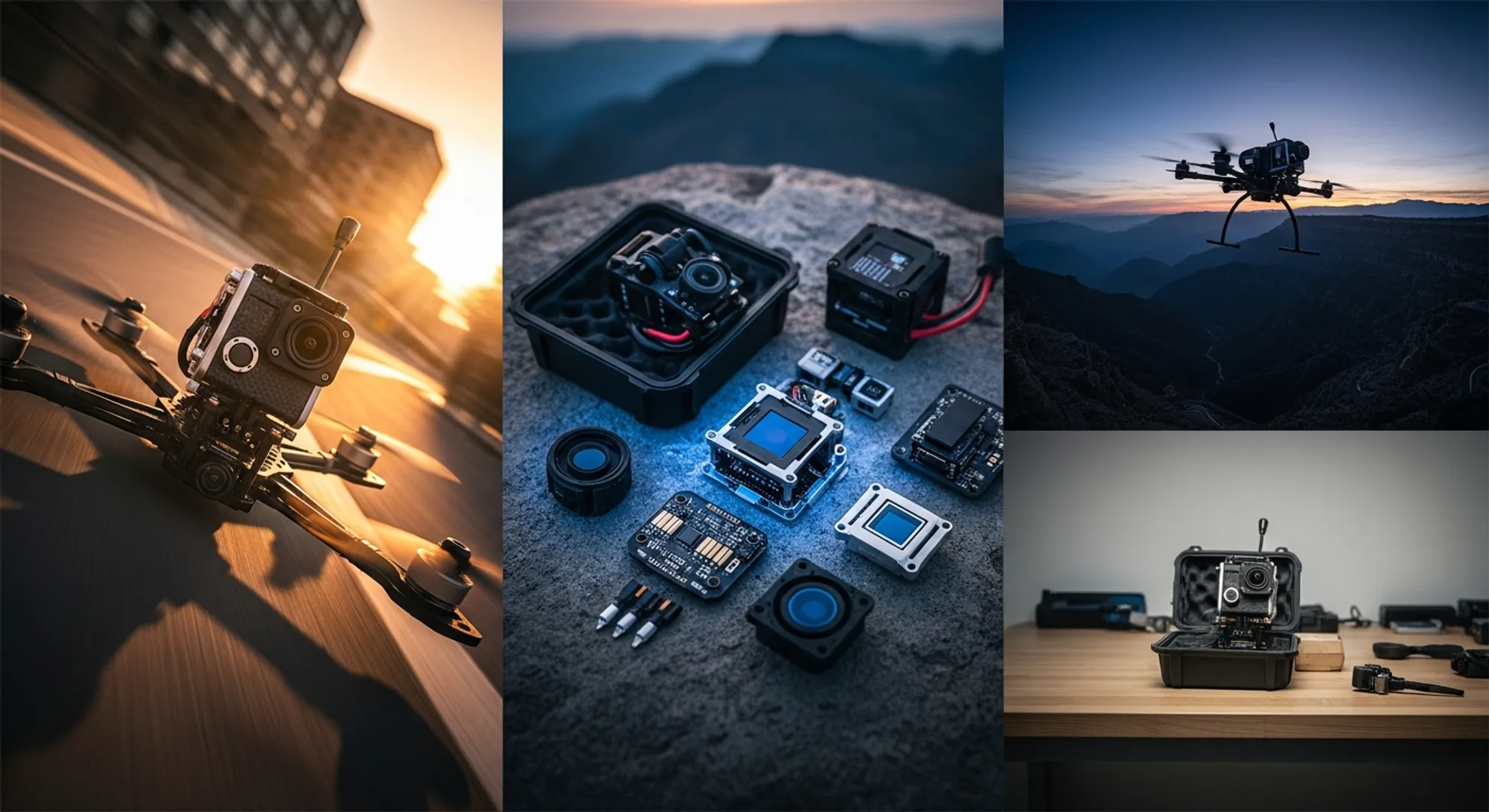
The "Naked GoPro" is not a product you buy off the shelf at a big-box store; it is a modification. It involves taking a flagship GoPro, disassembling it, and transplanting the sensor and motherboard into a minimal TPU or carbon fiber case. Power is supplied directly from the drone's flight controller or battery balance lead via a BEC (Battery Elimination Circuit).
Image Fidelity and Color Science
In 2026, the GoPro sensor remains the gold standard for FPV. The color science (flat profile) offers the most flexibility in post-production grading. If you are matching footage with a RED Komodo or an ARRI Alexa on a professional set, the Naked GoPro is your only real option in the micro class. For a deeper dive into high-end codec performance, check out our analysis on codec comparisons and ProRes workflows.
Stabilization: ReelSteady and Gyroflow
The magic of the Naked GoPro lies in the gyro data. While in-camera Hypersmooth is great, FPV pilots prefer logging gyro data to stabilize in post using ReelSteady or the open-source Gyroflow. Because the naked camera is hard-mounted (often with no dampeners to save weight), the ability to fine-tune stabilization smoothness and crop factor in post is essential.
Pro Tip: Naked GoPros are prone to overheating because they lack the thermal mass of the original heatsink. Never leave a Naked GoPro powered on while the drone is sitting on the bench. It requires airflow from flight to stay cool.
The Cons: Fragility and Complexity
This is not for the faint of heart. One bad crash can shear a ribbon cable or crack the sensor. Furthermore, the power delivery is sensitive; voltage spikes from the drone's ESCs can fry the motherboard if not properly filtered.
The Challenger: Insta360 (GO Series and Decased)
Insta360 has taken a different approach. Rather than forcing users to void warranties with screwdrivers, they developed the GO series and supported the "SMO" (stripped-down) camera market. In our Insta360 GO 3 capabilities review, we explored how these tiny modules changed the game for tight proximity flying.
The "Decased Insta360 Guide" Approach
Similar to the GoPro, you can decase 360 cameras like the X4 to create an ultra-light 360 rig. This allows for reframing in post, which is a superpower for solo operators. You don't need to be a perfect pilot; you just need to fly the line, and you can point the camera at the subject later.
Workflow Efficiency
Where Insta360 destroys the competition is workflow. The app integration and the ability to quickly export stabilized footage for social media (9:16 vertical crops) without complex proxy workflows make it the favorite for content creators who need to post daily.
Head-to-Head: GoPro vs Insta360 FPV
Here is how the two heavyweights stack up in a direct GoPro vs Insta360 FPV comparison for 2026 hardware:
1. Dynamic Range and Low Light
Winner: Naked GoPro. The larger sensor size and superior GP-Log encoding simply hold more highlight information. If you are flying indoors with bright windows (real estate tours), the GoPro will retain the view outside while exposing the interior. Insta360 tends to clip highlights faster.
2. Durability and Ease of Use
Winner: Insta360 (GO Series). The GO camera is a sealed unit. It can take a beating, get wet, and keep recording. A Naked GoPro has an exposed PCB. If you crash a Naked GoPro into wet grass, it is game over. For training or high-risk environments, Insta360 is the safer bet.
3. Post-Production Flexibility
Tie. This depends on your goal. For cinematic 16:9 masterpieces, GoPro with ReelSteady is unmatched. For creative framing and impossible angles, a decased Insta360 setup is superior. Refer to our guide on ND filter usage and stitching to see how to maximize 360 footage.
Naked Camera Conversion Kits: DIY vs. Pre-Built
If you have decided on the Naked GoPro route, you have two paths: build it or buy it.
The DIY Route
You can purchase naked camera conversion kits from brands like GEPRC, BetaFPV, or Flywoo. These kits include the front case, a BEC board (to replace the battery), and the necessary ribbon cables.
Cost: High risk (you might break the camera), lower price.
The Pre-Built Route
Retailers like GetFPV sell pre-decased cameras. These come tested, often with a warranty on the labor (though rarely on crash damage).
Cost: Higher price, zero risk of breaking it during assembly.
For those looking to turn this into a profession, proper training is essential. I highly recommend checking out Pilot Institute for their Part 107 and specialized FPV courses to ensure you are operating these custom machines legally and safely.
The Verdict: Which Should You Fly?
The decision comes down to your client and your flight environment.
Choose the Naked GoPro if:
You are shooting high-end commercials, real estate, or film work where color grading is required. The image quality is indistinguishable from a full-sized unit, but the drone performs significantly better. If you are comfortable with soldering and basic electronics, the visual payoff is worth the fragility.
Choose the Insta360 (GO or Decased) if:
You are a social media creator, vlogger, or flying in hazardous environments where equipment loss is likely. The speed of the workflow allows you to pump out content faster, and the horizon-locking features of the 360 modules allow for shots that physically aren't possible with a fixed-angle GoPro.
In 2026, the gap between "micro" and "cinema" has vanished. Whether you strip a GoPro or mount a tiny 360 cam, the sub-250g drone is no longer a toy—it is the most versatile tool in a cinematographer's bag.
Sources & Further Reading
- FAA Safety - Recreational Flyer Information & Weight Guidelines
- Pilot Institute - Drone Certification & FPV Training
- GetFPV - Retailer for Naked GoPro Kits & FPV Gear