

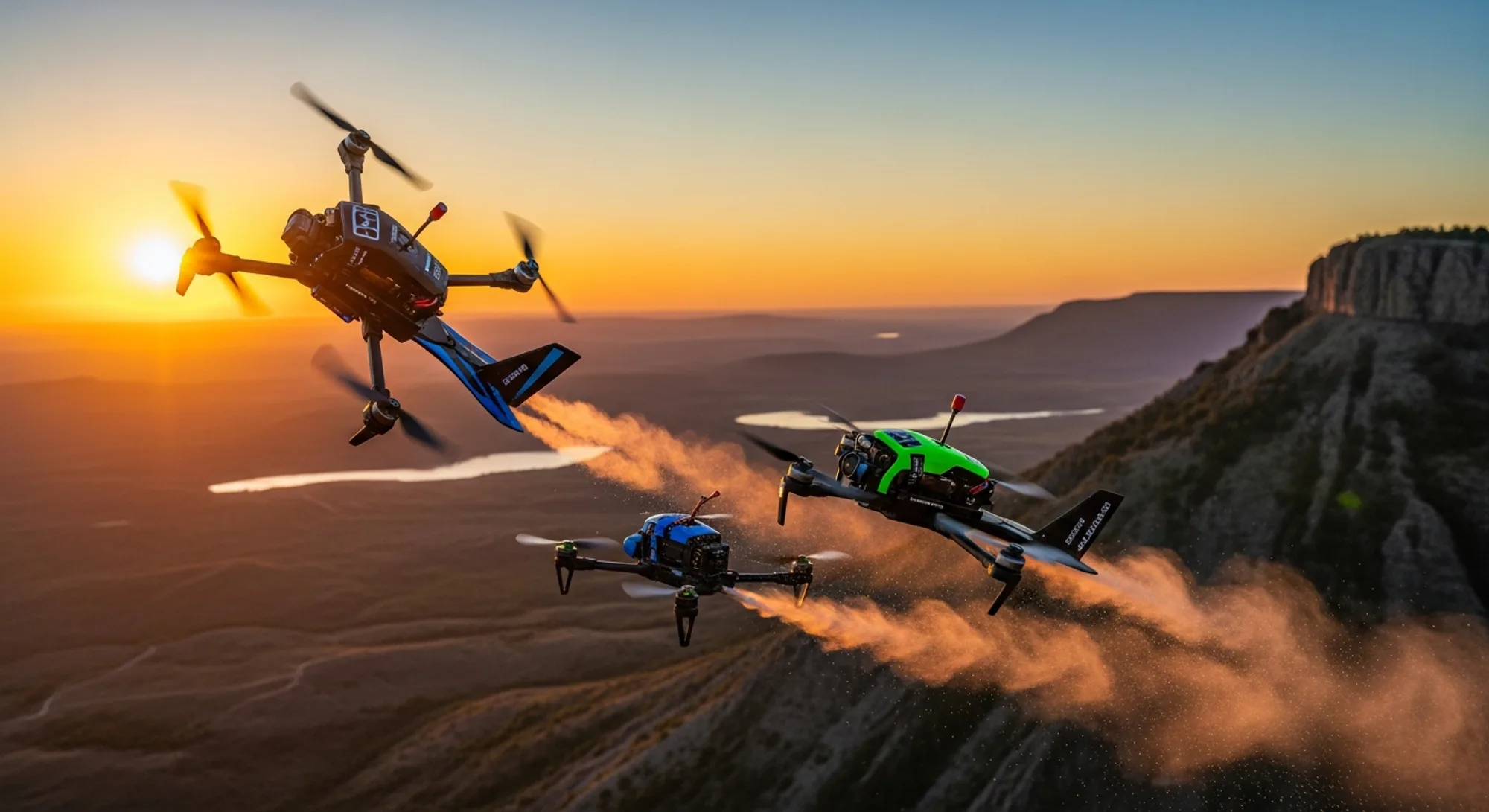
Key Takeaways
- Speed Differential: The custom 5" dominates high-speed motorsports (90+ mph), while the Avata 2 hits a ceiling around 60 mph—limiting it to mountain biking and running speeds.
- Durability: In 2026, carbon fiber freestyle frames remain field-repairable within minutes; the Avata 2's unibody design often requires a workbench for frame swaps after major crashes.
- Image Quality: The Avata 2 offers a seamless 10-bit workflow out of the box, but a 5" carrying a full-sized GoPro or Action 5 Pro still holds the edge for dynamic range and raw bitrate.
- Barrier to Entry: The Avata 2 is a "buy and fly" solution for solo journalists; the custom 5" requires soldering skills, PID tuning knowledge, and battery management discipline.
If you've ever tried to chase a rally car or a downhill mountain biker through dense forest, you know that the "perfect shot" is a negotiation between physics and fear. As we move through 2026, the divide between consumer "ready-to-fly" FPV drones and the raw, soldering-iron-required world of custom 5-inch freestyle quads has never been more distinct—or more confusing for newcomers.
In one corner stands the DJI Avata 2 (and its subsequent firmware iterations), a polished, sensor-laden cinewhoop that promises safety and ease. In the other, the timeless custom 5" freestyle drone—a carbon-fiber brick of raw power that demands respect and engineering know-how. For action sports drone photography, the choice isn't just about specs; it's about the specific demands of the subject you're chasing.
I've spent the last six months alternating between a stock Avata 2 and my custom-built 6S Apex frame with the latest O4 air unit. This is the definitive 2026 audit of which tool belongs in your camera bag.
The Hardware Philosophy: Plastic Unibody vs. Carbon Tank
To understand the performance differences, you have to examine the construction. The Avata 2 is a cinewhoop by design, featuring shrouded propellers, a plastic unibody, and integrated GPS/vision sensors. It's engineered to bounce off a tree and keep flying—or at least, not cut the tree down. This makes it the safer option for filming close-proximity sports like skateboarding or parkour, where the drone operates within feet of the talent.
However, that safety comes with aerodynamic penalties. The ducts act like sails in high wind. If you're filming kite surfers or ridgeline motocross, the Avata 2 fights the air rather than cutting through it.
The 5-inch FPV drone, conversely, is an open-propeller design. It's dangerous. It's loud. But it's aerodynamically superior. In 2026, we're seeing 5-inch builds using ultra-stiff carbon fiber and 2207 motors that generate nearly 2 kg of thrust per corner. This isn't just about top speed; it's about authority. When a drift car kicks up a wall of dirt, a 5-inch drone has the power to punch through the turbulence. The Avata 2 will often get tossed aside by the "dirty air."
The "Prop Wash" Factor
When descending rapidly to follow a skier off a jump, the Avata 2 struggles with "prop wash"—turbulence created by its own propellers. This causes shakes in the footage that even RockSteady stabilization struggles to correct. A well-tuned custom 5" cuts through its own wash seamlessly, allowing for vertical dives that look like they were shot on rails.
Flight Performance: The Need for Speed
The core of this DJI Avata 2 review comparison comes down to the throttle. In Manual (Acro) mode, the Avata 2 is fun, but it's electronically limited. It feels "floaty." For high-speed drone filming, this is a dealbreaker. When chasing a Rally2 car doing 80 mph on gravel, the Avata 2 is maxed out at full stick deflection just to keep pace. There's no headroom to reframe the shot or overtake the subject.
The custom 5" has no such limits. With a 6S LiPo battery, you're looking at top speeds exceeding 100 mph (160 km/h) and, more importantly, 0–60 mph times that rival a Formula 1 car. This allows the pilot to scrub speed to orbit a subject and then punch the throttle to catch up instantly.
| Feature | DJI Avata 2 | Custom 5" Freestyle (6S) |
|---|---|---|
| Top Speed | ~60 mph (Manual Mode) | 90–120 mph (Build Dependent) |
| 0–60 mph Acceleration | ~3.5 seconds | ~1.2 seconds |
| Flight Time (Hard Flying) | 12–15 minutes | 3–5 minutes |
| Wind Resistance | Level 4 (Struggles in gusts) | Level 6+ (Cuts through wind) |
| Acoustic Footprint | High-pitched whine | Low-frequency roar |
One critical aspect often overlooked is flight time. The Avata 2's battery management is impressive, offering 12+ minutes of aggressive flight. A custom 5" carrying a full GoPro is lucky to get 4 minutes. If you're filming a long downhill run or a continuous take, the Avata 2 wins on endurance alone.
Image Quality Pipeline: Integration vs. Flexibility
In 2026, the gap between the Avata's internal camera and a GoPro strapped to a 5-inch has narrowed, but the distinction remains. The Avata 2 records to an internal sensor that's essentially an Action 4/5 hybrid. It's convenient—you press record, get 10-bit D-Log M footage, and it looks great. For 80% of client work, especially social media deliverables, this is sufficient.
However, the drone chase camera 2026 standard for high-end production remains a dedicated action camera (like the GoPro Hero series or DJI Action Pro) mounted on top of the drone. The advantage lies in sensor size and separation. On a custom 5", the camera is soft-mounted on TPU (thermoplastic polyurethane) to absorb high-frequency vibrations. On the Avata 2, the camera is integrated into the vibrating airframe.
Furthermore, relying on a single camera for both the FPV feed and the HD recording (as the Avata does) compromises the FPV feed's latency and the recording's shutter speed flexibility. With a custom rig, my FPV camera handles the flight feed (low latency, high contrast), while the GoPro handles the cinema image (ND filters, fixed shutter speed).
For a deeper dive on how sensor choices impact your footage, read our guide on 48MP vs. 20MP: The 2026 Drone Sensor Buying Reality Check, which explains why megapixels aren't everything in high-speed scenarios.
Durability and Field Repair: The Crash Reality
You will crash. In action sports, if you aren't crashing occasionally, you aren't flying close enough. This is where the cinewhoop vs. freestyle drone debate becomes financial.
When you crash an Avata 2 hard into concrete or rock, the plastic frame often cracks, the gimbal is highly vulnerable, and repair usually means filing a DJI Care Refresh claim (3–5 days downtime) or a tedious 2-hour teardown to replace the unibody frame.
When you crash a custom 5" hard, you break a propeller ($0.50), you might delaminate a carbon arm ($12 replacement), and repair takes 4 minutes in the trunk of your car with a hex driver.
"I never go to a shoot with just one drone. But with the Avata, I need three complete units. With my custom fleet, I bring one drone and a bag of spare arms and motors. I can rebuild a 5-inch on a mountain peak. I can't rebuild an Avata there."
For those operating in regulated environments, repairability also intersects with compliance. If you're modifying your drone, ensure you're up to date on Remote ID requirements. We analyzed the enforcement landscape in our article: FAA Remote ID Fines 2026: We Analyzed the First Enforcement Wave.
The Learning Curve and Barrier to Entry
The Avata 2 is a gateway drug. Its Motion Controller allows someone with zero experience to fly relatively safely. Even with the FPV Remote Controller 3 (sticks), the "Pause" button provides a panic save that custom drones simply don't have. Lose video on a custom 5", and you disarm and pray. Lose video on an Avata 2, and it stops and hovers (usually).
The custom route, however, requires you to become a technician. You need to understand Betaflight, soldering, battery voltage sag, and radio frequencies. The reward for this steep learning curve is total control. You can tune the PID loop to feel exactly how you want—snappy and robotic, or loose and flowing.
Pro Tip: The Hybrid Approach
Many professional drone operators in 2026 carry both platforms. Use the Avata 2 for "people shots"—flying through the open window of a car, following a runner through a doorway, or proximity flying near crowds where safety is paramount. Switch to the custom 5" for "vehicle shots"—chasing the car at 90 mph, diving the waterfall, or tracking the motocross jump.
If you're looking to create complex shots that involve mimicking movement rather than raw speed, check out Mimic FPV Dives: The 2026 360 Drone Keyframing Guide for alternative techniques using 360 cameras.
Verdict: Which Platform Fits Your Work?
The DJI Avata 2 is the ultimate tool for solo content creators and journalists. It fits in a small bag, the batteries last substantially longer, and the footage is usable straight out of the camera. If your subject is moving under 40 mph (mountain biking, running, skateboarding), it's the superior choice due to its safety profile and workflow efficiency.
The custom 5" freestyle drone remains the king of high-voltage action. If you're filming motorsports, surfing, or diving cliffs, the Avata 2 simply lacks the power and aerodynamic authority to get the shot. The 5-inch is a dedicated cinema tool that requires a dedicated operator, but the results are unmatched in terms of dynamic energy and raw speed.
In 2026, the best pilot isn't the one who defends one platform over the other—it's the one who knows exactly which tool to pull from the bag when the director yells "Action."
Sources & Further Reading
- IEEE Spectrum – Technical analysis on drone aerodynamics and propulsion systems.
- DroneDJ – Latest firmware updates and specs for DJI Avata series.
- GetFPV – Source for custom 5" frame kits and motor specifications.
